
Guangdong Solicits Public Comments on Local Standard for Efficient Operation of Air Compressor Stations, Assessment Boundary Shifts from Single Machine to Station
Guangdong Solicits Public Comments on Local Standard for Efficient Operation of Air Compressor Stations, Assessment Boundary Shifts from Single Machine to Station
The Guangdong Provincial Energy Administration recently issued a notice soliciting public comments on the local standard "Standard for Efficient Operation of Power Air Compressors (Stations)" (draft for review), with feedback due by November 20. The standard targets the evaluation method for the operational efficiency of the entire air compressor station rather than the energy efficiency grade of a single unit.
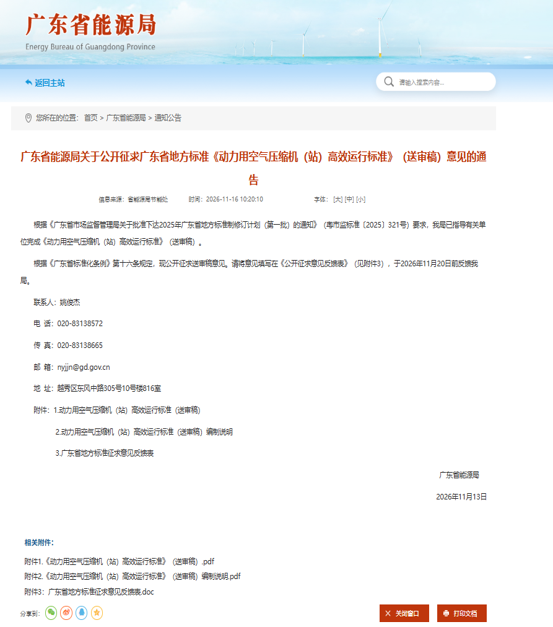
The direction of this standard's development is consistent with the change in the energy-saving logic on the policy side. The "Action Plan for Implementing the Comprehensive Conservation Strategy" previously issued by five ministries and commissions has already clarified the energy-saving direction of "stock" and "systems." After the revision of GB 19153, the energy efficiency evaluation boundary has also expanded from a single machine to the compressed air system including drying and filtration, and first-class energy efficiency of a single machine is no longer equivalent to first-class energy efficiency of the station. Guangdong's advancement of the evaluation of entire air compressor station operation in the form of a local standard means that the assessment criteria for air compressor station energy savings have moved from policy advocacy to an executable level.
For air compressor station system integrators and operation and maintenance service providers, the change brought by the implementation of the standard is the expansion of evaluation dimensions. In the past, what was compared was the specific power and price of a single machine. Once the operational efficiency of the entire station is included in the assessment, the purge air consumption of dryers, pressure loss of filters, pipeline network leakage, and group control strategies will all enter the evaluation scope. Enterprises that can provide station-level energy consumption diagnosis, system optimization, and continuous operation and maintenance services will be in a more proactive position in bidding and acceptance processes. The subsequent review progress and official implementation time of the draft standard for review are key nodes for observing the actual pace of advancement of energy-saving supervision of air compressor stations in Guangdong.