
Jingyi Releases ES Pro Next-Generation Energy-Saving Lubricant Series
Jingyi Releases ES Pro Next-Generation Energy-Saving Lubricant Series
It is well known that isothermal compression is theoretically the most efficient (most energy-saving) compression process for compressors. During compression, heat is generated due to volume reduction and molecular friction, causing temperature to rise and increasing compression power consumption. Isothermal compression refers to a compression process in which the heat generated is fully and promptly removed through adequate cooling, so that the gas temperature remains constant throughout. According to thermodynamic principles, the work consumed by isothermal compression is the theoretical minimum. In the indicator diagram below, the shaded area enclosed by 1-2?-3-4 represents the indicated work of isothermal compression, which is the "theoretical ceiling" of compressor energy savings.
However, in actual engineering practice, isothermal compression cannot be fully achieved, though it can be approached indefinitely. Actual compression processes (such as adiabatic compression and polytropic compression) cannot remove all the heat instantaneously, so the temperature rises and the actual work consumed is inevitably greater than the isothermal compression work; therefore, actual efficiency cannot reach 100%. To approach isothermal compression as closely as possible, practical compressors often adopt multi-stage compression and interstage cooling technologies: the compression process is divided into multiple stages, and after each stage the gas temperature is reduced to near the initial temperature through an intercooler before entering the next stage, thereby significantly reducing the total compression work and improving overall efficiency.
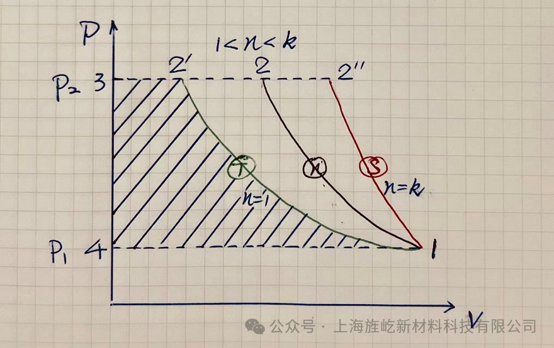
Compressor Compression Theory Indicator Diagram
Therefore, improving the gas cooling performance during compression is a key means of improving compressor efficiency. Lubricants play key roles in the compression process, including lubrication, sealing, cooling, and noise reduction. Thus, improving the heat transfer performance of lubricants can improve compression efficiency. In 2025, Jingyi launched the ES6 and ES7 series of energy-saving lubricants — "New Tricks for Compressor Energy Savings | Shanghai Jingyi High-Efficiency Coolants and Lubricating Greases Series" and "Relaxed Lubrication, Effortless Friction — Jingyi New Product Launch Dinner." After continuous technological iteration and verification in actual application scenarios, the company will grandly release the ES Pro series of energy-saving lubricants during PTC ASIA 2026.
Science
Technological Iteration: Nano-like Thermal Bridge Effects Between Molecules
Improving Thermal Conductivity and Specific Heat Capacity
The molecular structure of a lubricant has an important influence on its cooling performance. When heat is transferred, molecular structures with long main chains and few branches have better cooling performance. This is because the long main chain transfers thermal vibration energy to adjacent molecules through collisions, and the transferred energy rapidly propagates along the main chain to its ends via intramolecular heat conduction.
However, intermolecular thermal resistance is the bottleneck: there are gaps between molecules, and heat transfer between molecules is much more difficult than intramolecular transfer. The intermolecular thermal resistance is relatively large and becomes the bottleneck of the entire heat transfer chain. Even if intramolecular heat conduction is efficient, intermolecular thermal resistance still limits overall heat transfer performance. To solve the intermolecular thermal resistance problem, the ES Pro series lubricants adopt an innovative structure in which nano-like materials are coupled between lubricant molecules. These nano-like materials act like "thermal bridges," effectively reducing intermolecular thermal resistance and promoting heat transfer between molecules, thereby significantly improving the heat transfer performance of the lubricant and the efficiency of the compressor.
Science
On-Site Measured Data
Over the past year, the ES Pro series has been tested in actual applications on different customers and machine models.
Case 1: Brand A 100 kW unit. According to the comparison of the following data, ES Pro reduced specific power by 0.86% and 1.19%.
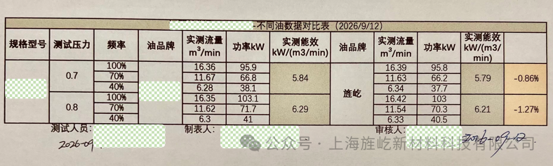
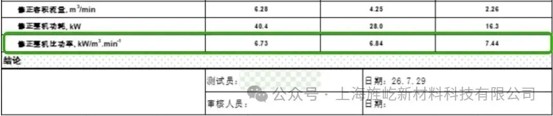
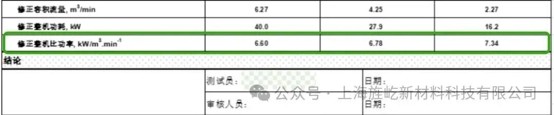
Case 2: Brand B 37 kW unit. According to the comparison of the following data, ES Pro achieved average energy savings of 0.8%–1.8%.
Benchmark lubricant test data:
ES Pro lubricant test data:
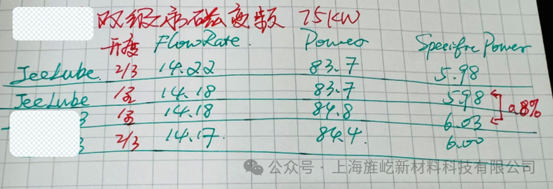
Case 3: Brand C, 75 kW two-stage permanent magnet variable-frequency unit. ES Pro achieved energy savings of approximately 0.8%.
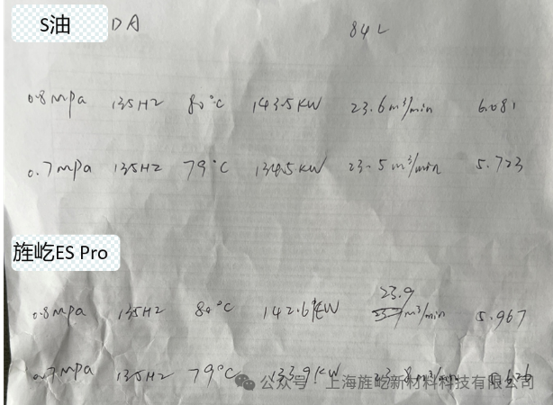
Case 4: Brand D, 140 kW two-stage permanent magnet variable-frequency unit. ES Pro achieved energy savings of up to 1.5%.
From the above cases combined, it can be seen that at the initial installation stage of new machines, ES Pro lubricant improves the isothermal compression efficiency of the compressor by enhancing heat transfer performance, achieving average energy savings of approximately 1%. Depending on the specific machine model and operating conditions, the actual energy-saving effect will vary.
Science
Impact of Lubricant Quality on Compressor Energy Savings
In the daily operation and maintenance of compressors, the reliability quality of lubricants — especially "carbon deposition" and "gumming" — has a major impact on compressor performance, and these reliability qualities further affect compressor energy efficiency.
Carbon deposition is a black, hard, coke-like substance formed by severe thermal cracking and deep oxidation of lubricants at extremely high temperatures (usually >130°C, or even localized instantaneous high temperatures), through dehydrogenation and polymerization of hydrocarbons. Its physical characteristics:
Dark black or charcoal gray in color, hard and porous, with extremely strong adhesion.
Usually appears in high-temperature and high-pressure areas such as discharge valve plates, discharge pipes, cylinder heads, and rotor tips.
Gumming (different from "coking") generally refers to a viscous gum-like substance or hard film similar to resin or varnish, insoluble in oil, formed by slow thermal oxidation reactions of lubricants at medium-to-high temperatures (usually 80°C–120°C). Its physical characteristics:
In the early stage, it appears as a yellow, amber, or dark brown transparent/semi-transparent lacquer film attached to metal surfaces.
At high temperatures, it may be soft and muddy or viscous and gummy, and hardens after cooling.
It readily adsorbs dust and wear debris in the system to form sludge.
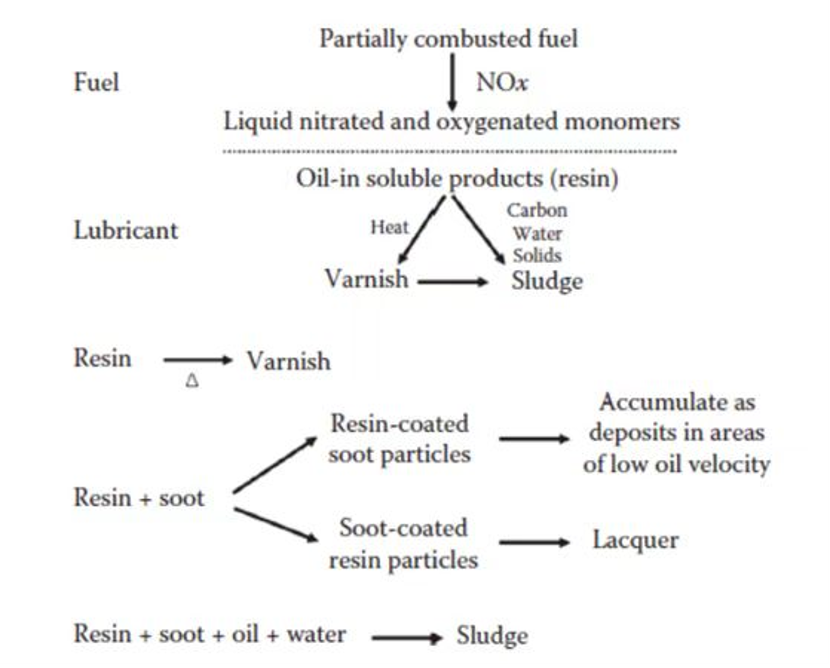
Image from the internet.
Science
Analysis of the Impact of Lubricant Quality on Compressor Energy Efficiency
Impact of gumming on the pressure drop of the oil-gas separator
Low-quality lubricants are prone to problems such as oxidative deterioration. The deposits and contaminants formed will clog the micropores of the oil-gas separation element, reducing its separation efficiency and increasing system pressure drop. Under normal circumstances, the pressure drop of the oil-gas separator is below 0.2 bar. With low-quality lubricants, starting at around 1,000 hours, quality degrades rapidly and the separator pressure drop increases rapidly, reaching up to 0.3 bar. The increased pressure drop will inevitably lead to increased energy consumption.
Taking a 7 bar twin-screw air compressor as an example, an increase in pressure drop of 0.1 bar will result in a 1% increase in operating energy consumption. ES Pro adopts an entirely new formulation system with excellent thermal stability, extends the effective oil change interval, and effectively prevents gumming during the oil change interval, with expected energy savings of up to 1%.
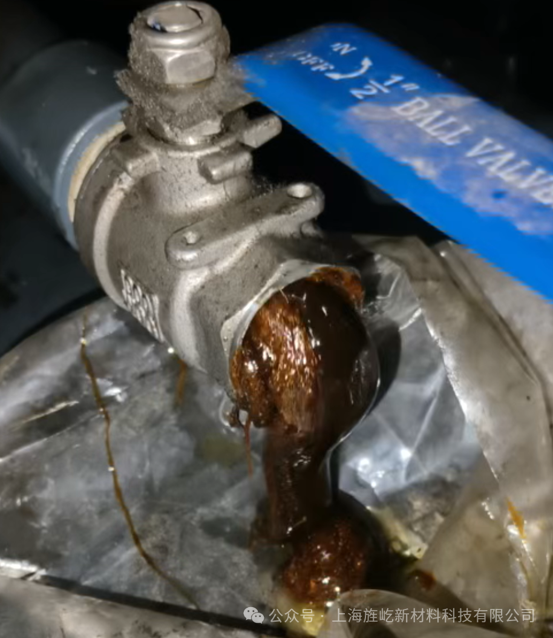
Oil-Gas Separator Oil Drain Valve Blockage
Impact of carbon deposition and gumming on friction pairs
Gumming and carbon deposition will deposit on the surfaces of high-temperature components inside the compressor (especially friction pairs such as bearings and rotors), affecting heat transfer efficiency and the efficient operation of components. For example, gumming and carbon deposition will raise the compressor's discharge temperature, reduce compression efficiency, and increase energy consumption. Surface lacquer films, gumming, and carbon deposition will increase the friction coefficient between friction pairs, and an increased friction coefficient means increased power consumption.
ES Pro lubricant has good oxidation resistance and self-cleaning performance, and can reduce the formation of lacquer films, gumming, and carbon deposition, maintaining efficient compressor operation. In addition, ES Pro has excellent heat transfer performance, effectively reducing high temperatures during the compression process and further mitigating the risk of high-temperature deterioration of the lubricant.
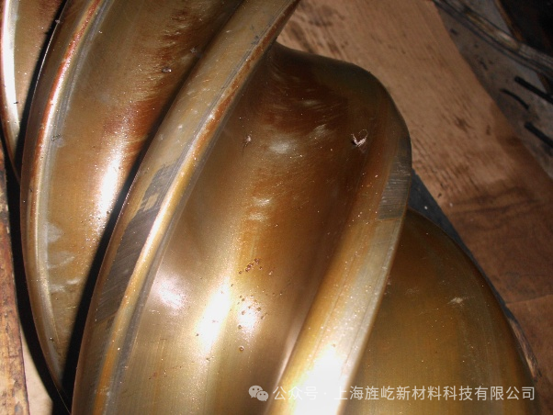
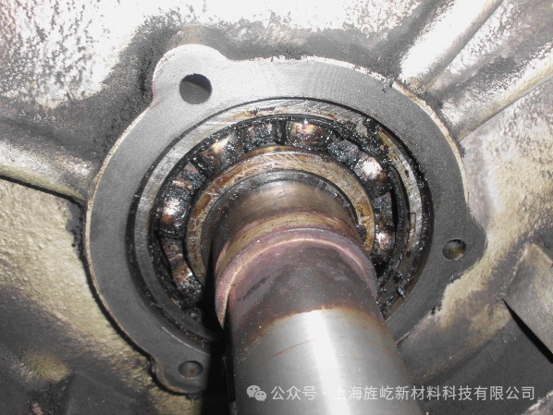
Gumming on the surfaces of compressor bearings and rotors
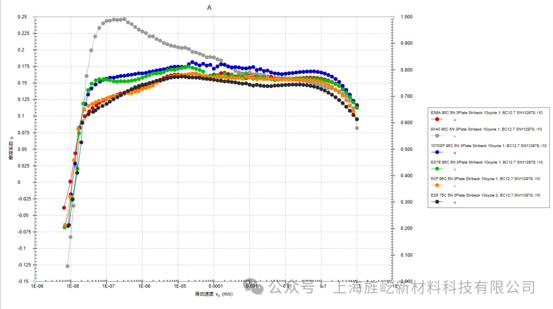
The figure below shows a comparison of the tribological Stribeck curves of ES Pro (labeled ES5 in the figure). It can be seen that the friction coefficient of ES Pro is about 2–3% lower than that of other lubricants. Therefore, it can be estimated that ES Pro can achieve average energy savings of approximately 2%.
Based on the above analysis, the ES Pro series lubricants from Jingyi can achieve comprehensive energy savings of approximately 4%:
By improving the isothermal compression efficiency of the compressor, energy savings of approximately 1%;
By improving the oil-gas separation efficiency of the compressor, energy savings of approximately 1%;
By improving the compressor's resistance to gumming and carbon deposition, energy savings of approximately 2%.
All images in this article are original works, and the copyright belongs to Shanghai Jingyi. Reproduction without written permission is prohibited; where reproduction is permitted, the source must be properly cited.